
How to Become a Corporate Lawyer in India: Step-by-Step Career Guide
What Does a Corporate Lawyer Do?
A corporate lawyer advises businesses on legal rights, obligations, transactions and regulatory risks. Unlike litigation lawyers, corporate lawyers generally work outside the courtroom. Their work can involve drafting and negotiating contracts, conducting due diligence, advising companies on investments and fundraising, handling mergers and acquisitions, and ensuring regulatory compliance.
Corporate law is also not a single career path. A student may eventually work in a law firm’s corporate or M&A practice, join an in-house legal team, or work in a regulatory, consulting or advisory practice.
Step 1: Understand Whether Corporate Law Suits You

Before choosing corporate law, understand what the work actually involves. Corporate lawyers spend considerable time reading and drafting documents, analysing clauses, researching legal issues and working around transaction deadlines. Small differences in wording can have significant commercial consequences.
A useful way to test your interest is to read an actual commercial document, such as a company’s terms of service or a publicly available agreement. If analysing clauses and understanding how the document works feels intellectually interesting, corporate law may be worth exploring further.
Why I Chose Corporate Law
Personal perspective
I chose corporate law for two main reasons. The first was the subject itself. Company law, securities law and the way businesses are structured, funded and regulated genuinely interested me. The second was the compensation. Corporate law generally offers a higher pay scale than many other areas of legal practice, and I do not think there is anything wrong with considering that when choosing a career.
What I misunderstood initially was the working schedule. I assumed corporate law would largely be a steady 9-to-5 desk job. After years of studying law and gaining practical experience, I have realised that the schedule is usually determined by transactions and deadlines rather than the clock.
If you are considering corporate law, it is important to understand this reality before entering the field.
Step 2: Choose Your Law Degree
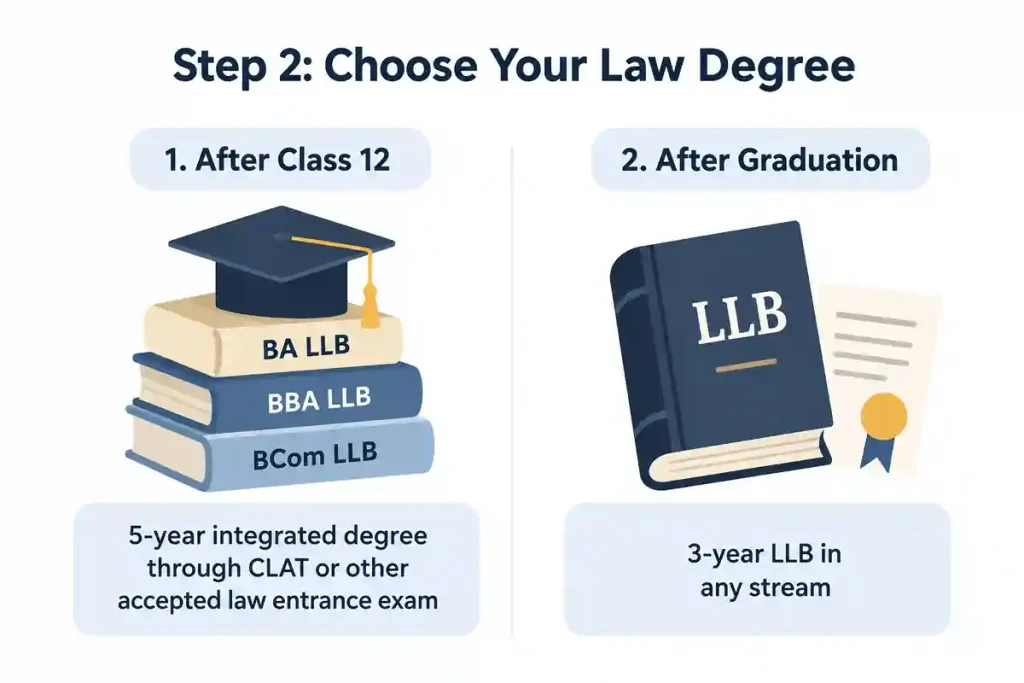
There are two common routes into the legal profession in India. Students entering law after Class 12 can pursue a five-year integrated programme such as BA LLB or BBA LLB. Students who have already completed graduation can pursue a three-year LLB.
For students specifically interested in corporate law, courses such as BBA LLB or BCom LLB can provide additional exposure to business and commerce subjects, although a BA LLB can also lead to a corporate-law career.
Step 3: Choose Your Law College Strategically

Your law school can influence access to internships and campus recruitment, particularly at large corporate law firms. The source material notes that leading firms recruit heavily from top National Law Universities, while students from other institutions can build their profiles through internships, networking and off-campus applications.
This does not mean that your college completely determines your career. It means that students should understand the recruitment ecosystem early and compensate for limited campus opportunities through practical experience and professional networking.
Step 4: Build the Skills Corporate Lawyers Actually Use
A law degree alone does not prepare you for the day-to-day work of a corporate lawyer. During law school, focus particularly on contract law, company law, securities law, competition law, insolvency and banking law. Reading the legislation itself alongside textbooks and notes can also improve your understanding.
Drafting is equally important. Practise working with clauses such as indemnity, confidentiality, representations and warranties, termination and dispute resolution. Corporate lawyers also need basic commercial awareness, including the ability to understand financial statements, term sheets and developments affecting businesses.
Clear writing matters as well. Being able to reduce a lengthy legal issue into a short and accurate explanation is a practical skill that becomes increasingly important in professional work.
Step 5: Use Internships to Understand Corporate Law

Internships are one of the most important ways to understand corporate practice before graduating. A useful progression is to gain basic professional exposure initially, move towards corporate or in-house work during the middle years of law school, and then target the firms or practice areas in which you eventually want to work.
The objective should not simply be to collect internship certificates. Each internship should help you understand a different aspect of legal work, improve your drafting and research, and develop relationships with lawyers who can provide feedback or guidance.
For students outside the traditional recruitment pipeline, off-campus applications, boutique firms and in-house teams can provide additional entry points.
Step 6: Understand the AIBE and Bar Enrolment
After completing an LLB, students who intend to practise as advocates need to comply with the applicable enrolment requirements and qualify through the All India Bar Examination. The source material notes that the AIBE is an important part of the route to practice, even though the relevance of active advocacy practice may differ for lawyers pursuing purely transactional corporate roles.
Students should therefore understand the current Bar Council requirements applicable to them rather than treating the examination as an afterthought.
Step 7: Get Your First Corporate Law Job
There are several routes into corporate practice. Campus recruitment and pre-placement offers are important routes for students at colleges with strong corporate recruitment. Off-campus applications provide another route, particularly when applications are targeted towards a specific practice group rather than sent as generic mass emails.
Another option is to begin in an in-house legal department, where junior lawyers may work on contracts, compliance and general corporate matters. An LLM is another possible route for students who want to specialise or change their academic profile, but it is not a mandatory requirement for becoming a corporate lawyer.
What Is the Salary of a Corporate Lawyer in India?
Corporate-law salaries vary substantially according to the firm, city, practice area, experience and recruitment route. Reported fresher salaries in the source material range from approximately ₹14–23 lakh at some leading firms to substantially lower figures at smaller firms. These figures should be treated as reported ranges rather than guaranteed salaries.
Compensation is therefore one factor to consider, but it should be evaluated alongside the nature of the work, training, practice area and working environment.
The Part About Corporate Law That Nobody Should Ignore
Personal perspective
If I could give one piece of advice to someone starting out, it would be to choose the area of law you genuinely want to work in.
If you choose corporate law, you may spend 10 to 12 hours a day working on documents, transactions, research and deadlines. That is a significant portion of your life to spend on something you are only mildly interested in.
The pay and prestige can be attractive, but they may not be enough to make years of late nights satisfying if you do not enjoy the underlying work. People are drawn to different parts of corporate practice—company law, securities, M&A, banking and finance, private equity or regulatory work. Finding the subject matter that genuinely interests you matters.
Before committing to the field, spend time around the actual work. Do internships. Read transaction documents. Observe how corporate lawyers spend their days. Then make the decision.
If the work still interests you after seeing what it actually involves, the long hours become a trade-off you understand rather than a surprise you discover later.
Common Mistakes Students Make
One common mistake is treating the law degree itself as sufficient preparation. Corporate practice requires additional drafting, research, commercial and communication skills. Another is collecting internships without considering whether they are helping build a coherent profile.
Students should also avoid choosing a firm solely because of its reported salary. The nature of the practice, quality of training and kind of work you will actually perform can significantly shape your early career.
Frequently Asked Questions
How long does it take to become a corporate lawyer in India?
The five-year integrated LLB is the most direct route after Class 12. Students who already have a bachelor’s degree can pursue a three-year LLB. Internships, recruitment and early professional experience then determine how quickly a person enters corporate practice.
Do I need to graduate from an NLU to become a corporate lawyer?
No. A strong law-school brand can provide greater access to certain recruitment opportunities, but students from other institutions can pursue corporate careers through internships, networking, off-campus applications and other entry routes.
Is an LLM necessary for corporate law?
No. An LLM is optional and may be useful for specialisation or for students seeking to change or strengthen their academic profile.
Can corporate lawyers work without appearing in court?
Yes. A substantial part of corporate legal work involves transactions, contracts, due diligence, regulatory advice and compliance rather than courtroom litigation.
Conclusion
Becoming a corporate lawyer in India is less about following a single prescribed route and more about progressively developing the skills, experience and professional exposure required for corporate practice.
A good starting point is to understand the work before deciding that you want the career. Study the relevant subjects, develop drafting and commercial skills, use internships to test your interest and understand the recruitment routes available to you.
Most importantly, do not choose corporate law only because it appears prestigious or well-paid. Spend enough time around the actual work to decide whether the subject itself interests you.
